Showing posts with label A Beer C's. Show all posts

Wednesday, February 18, 2015

The A Beer C's: Part Three

Knowing your "A Beer C's" is helpful for both learning and talking about beer. For earlier installments of this series, click here.


G is for germination:
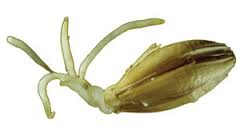
Germinating barley. Picture courtesy of Biokemi.
In order for barley to be turned into beer, it must first be germinated. This means its the grain should be at the point of already sprouting a plant. Only then will the yeast have access to enzymes required for fermentation. Brewers germinate grain through the malting process, which involves encouraging plant growth by steeping the grain in hot water, then killning the grain in order to halt the growth process before the plants have used up their enzymes for their own purposes.


H is for Hefeweizen: 


Hefeweizens are served in Bavarian Weizen glasses.
This Bavarian beer style is often the catalyst for turning many occasional beer drinkers into complete craft enthusiasts. Brewed wth wheat instead of barley, Hefeweizens use sexual yeast to produce a sweet and spicy character likened to a banana/clove combination. Low bitterness levels contribute to this beer's popularity among those who are "new to beer."


I is for IBU: 

The IBU equation. Picture courtesy of IPABeer.com.

IBU stands for International Bitterness Units, and uses a numerical range to indicate a beer's amount of Hoo bitterness. Since bitterness often influences a customer's choice of beer, IBUs, which generally fall between 10 and 120, are often printed on bottles and beer menus. When comparing beers, you may find that some beers will taste more bitter than those with higher IBUs. This is because bitterness is also influenced by the type and amount of malt used. 

Monday, January 26, 2015

The A Beer C's: Part Two

Be sure to check out Part One of this educational series by clicking here! 

is for Diacetyl: 

Diacetyl: It's often a homebrewer's most stubborn enemy. You know you have a "diacetyl bomb" on your hands when your beer tastes like buttered popcorn and has a slick, oily texture. Its creation is unavoidable, as it is a natural byproduct of the brewing process. However, when it comes to the finished product, diacetyl is highly undesirable for most beer styles. Warmer fermentation temperatures will help to get rid of diacetyl, which why it is it is more acceptable for lagers to show hints of this chemical-- lagers ferment at lower temperatures than ales (for the difference between lagers and ales, see -my article on "How to Talk Anout Beer 101"). Homebrewers and beer judges often practice detecting diacetyl by spiking beer with imitation butter. 

E is for Ester:

The fruity flavors found in some beers don't come from fruit juice infusion. Instead, they come from esters, yeast-derived flavor compounds created during fermentation. While esters are hallmarks of many Belgian beer styles such as Witbiers and Hefeweizens, they are not suitable for "cleaner" tasting beers, like Pilsners. Brewers help control ester production by carefully choosing the yeast strain they want to work with. Ester production is catalyzed by an enzyme called acetate transferase, or AAT. The more AAT a yeast has, the more fruit-filled the beer it's used to create is bound to taste. Ester production is also increased by higher fermentation temperatures, which is another reason why they are not usually detected in lagers.

F is for Fermentation:

We all know alcohol is produced through fermentation, but few of us have a good grasp on just what fermentation involves. Fermentation requires just two ingredients: yeast and sugar. When yeast is added to the mash, a concoction created by boiling germinated grain, beer begins to ferment. Yeast eats the natural sugars found in the mash, and converts them into carbon dioxide and alcohol. 

Monday, January 5, 2015

The A Beer C's: Part One


A is for Attenuation:

Sometimes beer critics will praise a beer by saying it is “well attenuated.” This is a particularly sought after characteristic in crisp, clean beers such as Oktoberfests and Pilsners. Attenuation refers to the amount of sugar that was consumed by yeast and converted into alcohol during the fermentation process. A higher level of attenuation means a lower level of residual sugar, resulting in a dryer taste. An under-attenuated beer can be overly sweet and thick, and is often caused by unhealthy yeast tiring out before they’ve completed their sugar chomping. Brewers calculate attenuation by using a hydrometer to measure the beer’s gravity at the beginning and end of the fermentation process. A well attenuated beer will have a greater decrease in gravity.

B is for Balance:

Any beer, regardless of its style, should have a balanced taste. For example: Although IPAs are known for being bitter and Eisbocks are known for being sweet,  no one wants an IPA that tastes like pure coffee grounds or an Eisbock that tastes like straight maple syrup. Brewers must work to create and execute balanced recipes in order to produce beers which palpable, yet true to style. A well balanced beer can also taste more complex:  without one element outshining the others, the palate is able to pick up on more flavors. However, it is quite possible to have a complex beer without balance—some beers taste as though the brewer was trying to incorporate too many different flavors, which just don’t seem to mesh.

C is for C-Hops:

The term “C-hops” is used to refer to several types of hops which are common to American ales and all happen to start with the letter C. These hop types include: Centennial, Cascade, Chinook, Citra, and Columbus. They produce intense citrusy, resinous, and earthy aromas and flavors in contrast to the more subdued, floral and spicy sensations emitted by “noble hops” used in European style beers.